
Klamath Falls City Directory Holdings
Klamath County Museums holds the verified starting shelf for any historical Klamath Falls directory search. Its digital collection offers scanned, searchable volumes for 1905, 1909, and 1920. Three volumes are three volumes. They are not proof of an unbroken annual run. The Museum hub lists each year as a separate item, so a name missing from one book may reflect a variant spelling, a rural address, an unscanned year, or plain non-inclusion. Treat every hit as a dated clue worth checking elsewhere.
| Collection | Years | Where held | Access |
|---|---|---|---|
| Digitized Klamath Falls directories | 1905, 1909, 1920 | Klamath County Museums | Scanned and searchable digital volumes |
| Newspaper Headline Indexes | 1899 to 1909 listings | Klamath County Museums | Indexed headline leads, then verify an issue |
| Historic Oregon Newspapers | Local papers through 1965 | Oregon Digital Newspaper Program | Keyword search through the library route |
| Released federal census | Latest public population census: 1950 | National Archives | Use with an identified household and date |
The Klamath County Museums city-directory collection leads straight to the three digitized volumes.
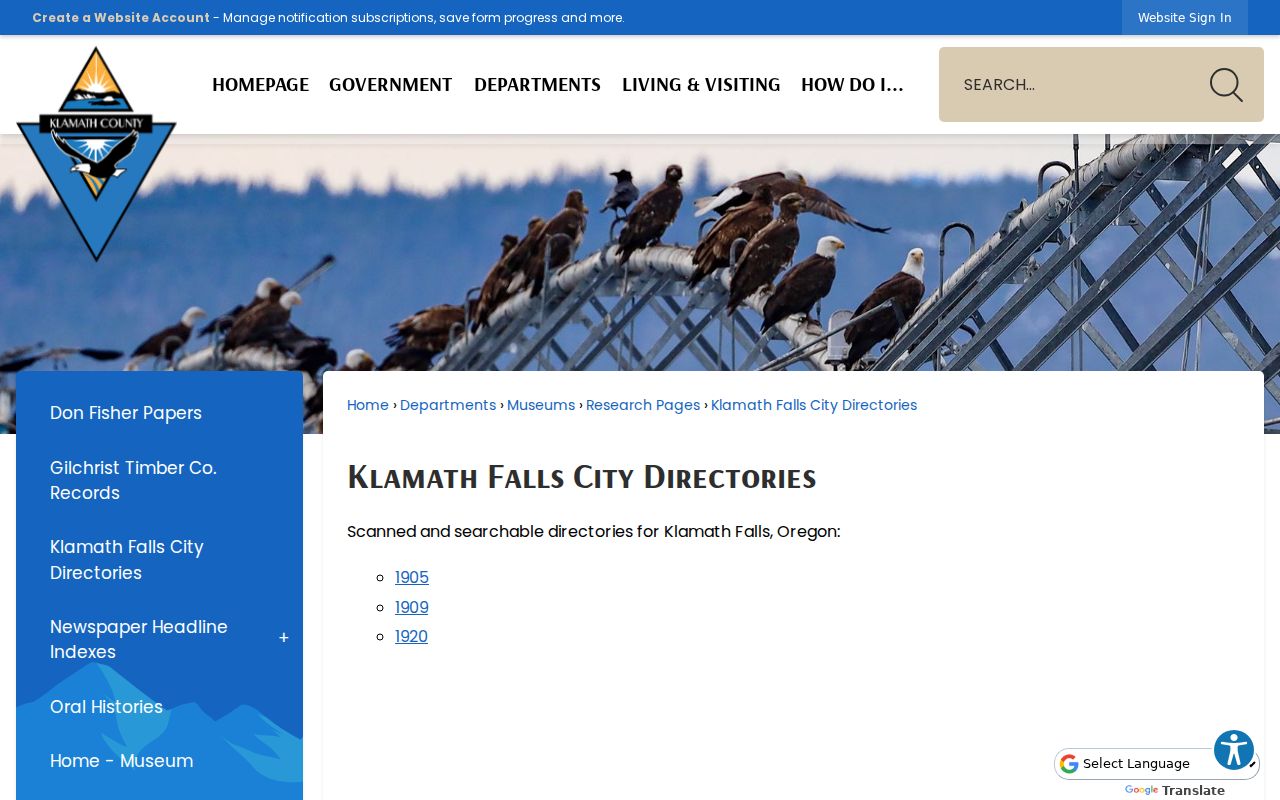
Open the Museum listing and pick a specific year. Do not assume the collection fills every gap between volumes. Note: A directory entry records a historical appearance, not a present household roster or a current ownership finding.
Klamath Falls City Directories Online
Begin with the surname exactly as family papers spell it. Then try initials and plausible variants across the three digitized Klamath Falls volumes. Transcribe only what the entry itself shows. The volumes publish no local abbreviation key or publisher notes. A legible page image, not a general directory convention, controls the reading. An address, occupation, or business line can suggest the next record to pull. Gaps carry meaning too. A missing name does not prove a move. It does not prove a death or that no one ever lived in Klamath Falls. Rural households sometimes went unlisted. A given year may not be scanned. Or the compiler may have preferred a different name form. Record the volume year beside each note. Then find a second dated source before concluding anything about family history.
Reading a Klamath Falls City Directory
Treat each Klamath Falls historical entry as a compact, dated record rather than a biography. Copy the name exactly as printed, initials and punctuation included. Then study the address and any occupation or business wording on the page. Relationship phrases, ownership marks, and abbreviations must be read from the volume itself. These local directories follow no documented spouse notation, residence mark, or publisher scheme. So the printed page is the only authority.
| Name form | Copy the surname, initials, and spelling exactly as displayed. |
|---|---|
| Address | Record the printed location, while noting that older streets can use a different address language. |
| Occupation or business | Keep any visible wording as a newspaper or archival search term. |
| Relationship wording | Transcribe it only when it is visibly printed in that entry. |
| Volume date | Attach the year to every note so later comparisons stay grounded. |
- Criss-cross directory
- A street-ordered directory format. No Klamath Falls criss-cross run was verified in the research, so do not assume one exists.
- Householder index
- An index arranged around a household or address. It can help organize a search, but it is not proof of every occupant.
- Abbreviation key
- A volume's own explanation of shortened terms. Read that key before assigning meaning to a symbol or letter.
Klamath Falls Directory Newspaper Trails
A directory year gains depth when paired with local reporting. Klamath County Museums maintains a Newspaper Headline Indexes collection spanning 1899 to 1909. It captures only a small share of local headlines. The Klamath County Library also points researchers to Historic Oregon Newspapers. These include the Klamath Falls Evening Herald, Klamath News, and Herald and News coverage through 1965. Search the name, address, business, and likely relatives separately.
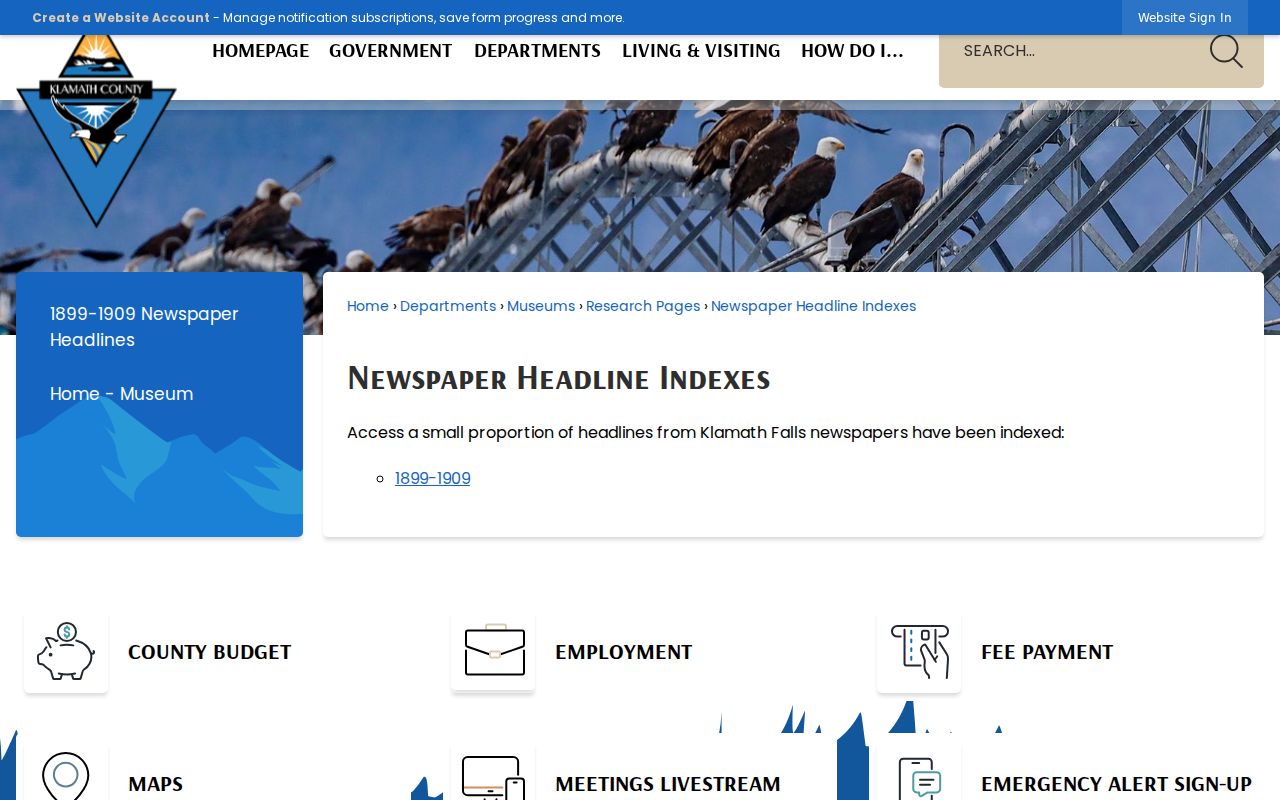
An index hit is only a pointer. It names an issue and a page. Read the original item before treating it as evidence of an event, a relationship, or an address. Newspapers and directories answer different questions. The directory fixes a named appearance at publication time, while a newspaper may supply an event date, a business notice, or an obituary lead. Neither source alone gives a complete household list.
Klamath Falls City Directory Library Access
The Klamath County Library genealogy service opens doors well beyond the printed directory. Ancestry Library Edition runs on public computers at the Main Library or over branch wireless. The Main Library is also a FamilySearch Affiliate Library. That status can unlock some restricted FamilySearch images on its computers or wireless, subject to rights limits. HeritageQuest works remotely with a Klamath County Library card. The Main Library sits at 126 South Third Street in downtown Klamath Falls. Its posted hours are Monday, Friday, and Saturday from 10 a.m. to 5 p.m. Tuesday through Thursday runs from 10 a.m. to 8 p.m. Sunday hours are 1 p.m. to 5 p.m. Call ahead before traveling. The reference desk is another practical channel when a collection must be used on site. The Klamath County Library genealogy service names both its on-site and remote research options.
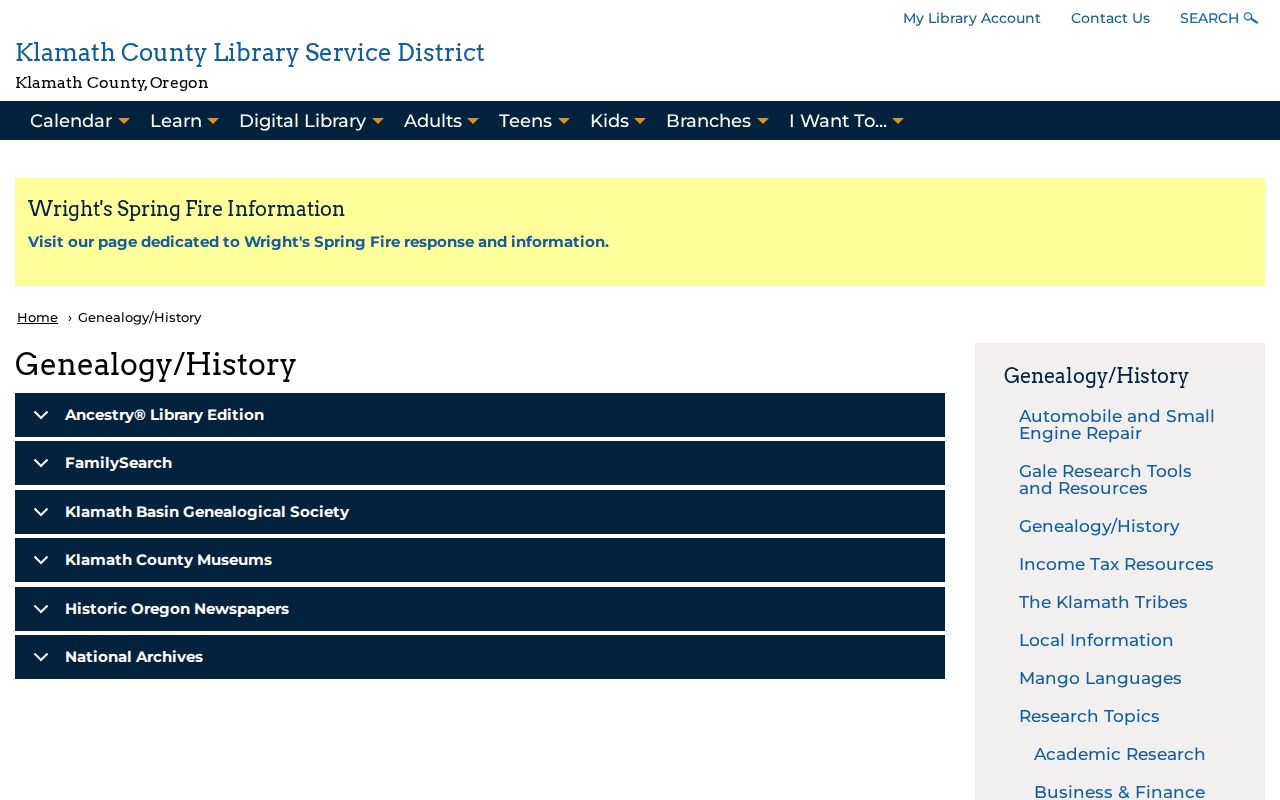
Library tools can widen a directory lead into census, land, court, or vital-record research. Rights restrictions may still block an individual image. The Klamath County Library local-information collection gives a second entry point whenever newspaper or yearbook context would sharpen a Klamath Falls directory search.
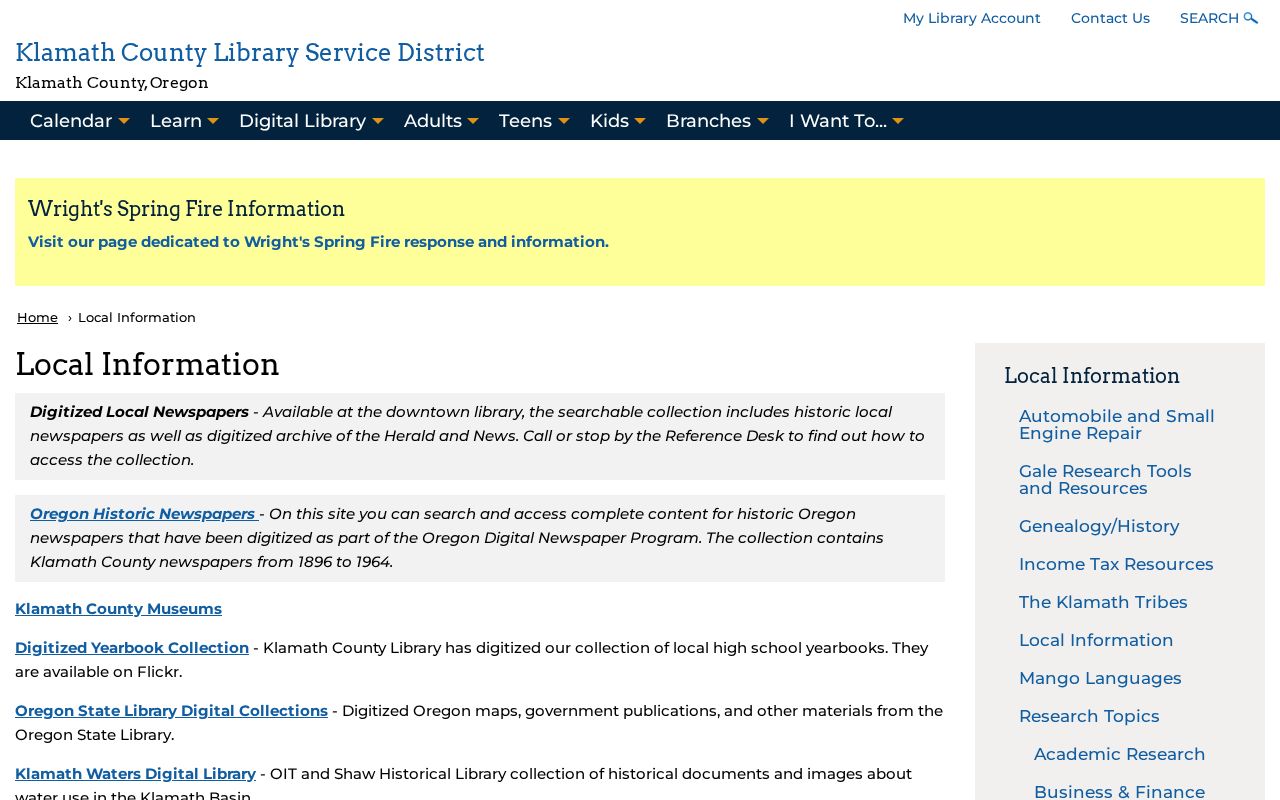
Treat each named library resource as its own evidence channel, never as one merged record about a person.
Linkville in Klamath Falls Directory Searches
Early research here demands a second name. Before 1893 the city was Linkville. Klamath County itself was carved from Lake County in 1882. A land paper, newspaper notice, or old map may carry the Linkville name instead. The same document may even predate the county altogether.
So when a modern Klamath Falls residents directory search stalls, try the historic name. Keep the source's own date and custody distinct from the current city name. The City of Klamath Falls history gives the rename its context. It dates incorporation to 1905. That year matches one digitized city directory. Treat the shared date as a chronology marker only. It does not prove the volume lists every resident of the later city.
Tracing Klamath Falls City Directories
A household trail holds up best when each entry is anchored. That means every Klamath Falls city directory record should sit between other dated records. The Museum's three years form a careful sequence rather than an annual chain. Those years are 1905, 1909, and 1920. Compare spellings, addresses, occupations, and business wordings across them. Then carry the same wording into the headline index and Historic Oregon Newspapers. Where an address matters, set the historical map context beside the current parcel's legal description. Never assume an old deed will show a modern street number.
- Open one verified directory year and transcribe only visible name, address, and business or occupation wording.
- Repeat the search in the other two digitized years, preserving each spelling variation and date.
- Search the Museum headline index and historic newspapers with the name, address, business, and possible relative.
- Compare the address with a verified historical map or Sanborn sheet, then use parcel and legal-description records for land context.
- Pair the result with the nearest released federal census and the appropriate probate, vital, or archival route when the dates support it.
The National Archives 1950 Census resource is the newest federal population census open to the public. It works as a cross-check, not a stand-in for a directory year.
Note: Record the source date beside every household note, because a move, sale, or family change can occur between published records.
Klamath Falls Directory Maps and Archives
Special collections and maps can decode an old address. A Klamath Falls directory entry may no longer match a modern location. The State Archives inventory lists Sanborn periods. Coverage runs 1911 to 1916, 1921 to 1930, and 1931 to 1957. It also notes Metsker atlases for 1936 and 1961. The Library of Congress holds a 16-sheet map from May 1911. Together these give street and neighborhood context. A deed's legal description still controls the land reference.
The Shaw Historical Library at Oregon Tech keeps regional books, maps, manuscripts, and photographs. It also holds oral histories and special collections. Its status notice reports a closure until further notice after a water leak. Call ahead before visiting. Materials are normally closed-stack, and donor or state restrictions can apply.
Shaw's holdings complement rather than duplicate the Museum's scanned directories and the library's research databases.
Klamath Falls Directory Access Limits
Historical collections carry practical limits. The Klamath County Museum's online directories and newspaper indexes are the self-service route. Its current FAQ states the Museum is not accepting research requests. The Klamath Basin Genealogical Society offers fee-based help through its own request form. That help covers obituary lookups and other research. Still check the original issue, record, or image yourself. A catalog listing never guarantees staff service or a particular volume on demand.
Used carefully, historical directories suit family history and place history. They also help with reconnecting a historical household and estate research. They do not prove a living person resides at an address now. Never use a historical entry to stalk, harass, or harm anyone. Modern street and parcel questions belong with the current address tools in the Klamath Falls by-street directory.