
Finding Klamath Falls Resident Records
Klamath Falls has no verified government roster of everyone who lives in town. The usable route is a record trail. A parcel account can identify the owner and tax-mail contact for a property. A recorded instrument can show parties to a deed or lien. A court register can confirm a case lead, while a historical directory can place a person at an address in a particular year. None of those sources alone proves a current household. The Klamath Falls residents directory question is answered by comparing independent records and keeping the date of every result visible.
Start with the office that owns the record, not a broad people-search result. County property and recording material belongs with Klamath County. City-created files belong with the City Recorder. Circuit files stay with the court, and Oregon vital records have their own eligibility rules. When a search produces a name or mailing line, preserve the parcel number, document number, case number, or date. Those identifiers make it possible to check the same fact with the proper custodian.
- For an address, check the Assessor parcel record and note the property ID, MTL, owner, and situs address.
- Use Land Explorer to compare the parcel with its legal description, nearby map context, and city or county jurisdiction.
- Use the Clerk’s recorded-document route by party, document number, or recording date when an instrument is needed.
- For a dated household question, check the Museum’s digitized directories, newspapers, and released census material.
- When an online index ends, send a narrow written request to the City, County, court, OHA, or Archives custodian that holds the record.
Note: A negative result means only that the permitted source did not return a match on that date.
Klamath Falls Records Offices for Residents
Four offices provide the clearest starting points for a Klamath Falls residents directory search. The County Clerk keeps recorded-property instruments and administers elections. The Assessor maintains the property roll and historic assessment channels. Klamath County Elections handles local voter records and exemptions. The City Recorder handles city-created records, not county deeds or assessment files. Each office has a different index and a different limit, so a useful request identifies the record type first.
Klamath County Elections
305 Main Street
Klamath Falls, OR 97601
541-883-5134
City of Klamath Falls Recorder
500 Klamath Avenue
Klamath Falls, OR 97601
541-883-5325
For a street-by-street parcel trail, use the focused workflow in the Klamath Falls address directory. It keeps parcel, deed, and map evidence separate from a claim about current occupancy.
Klamath Falls Land Explorer Searches
Klamath County Land Explorer is the most fully documented public map search in the local records system. It uses one text and autocomplete control rather than a multi-field tax form. The search hint accepts a PropID, MTL, owner, address, street, or survey. The system also searches road and survey sources, and its PLSS option uses township and range. It returns no more than six suggestions, results, or recent entries, and it auto-selects the first item. That makes exact parcel identifiers especially useful when names or streets are common.
| Land Explorer field | Source searched | Required | Verified use |
|---|---|---|---|
| Search | Text and autocomplete | No | PropID, MTL, owner, address, street, or survey |
| Taxlot fields | OWNER_NAME, PROP_ID, MTL, SITUS_ADDRESS | No | Displays an owner result |
| Road search | Roads and U.S./Forest Service Roads | No | Street field |
| Survey search | Survey layer | No | Subdivision, land partition, adjustment number, or county |
| Township and range | PLSS layer | No | TRNAME |
The County GIS transition page explains why the public map routes may change. The image below shows that official GIS handoff, which is useful when an older map bookmark no longer reaches the active application.
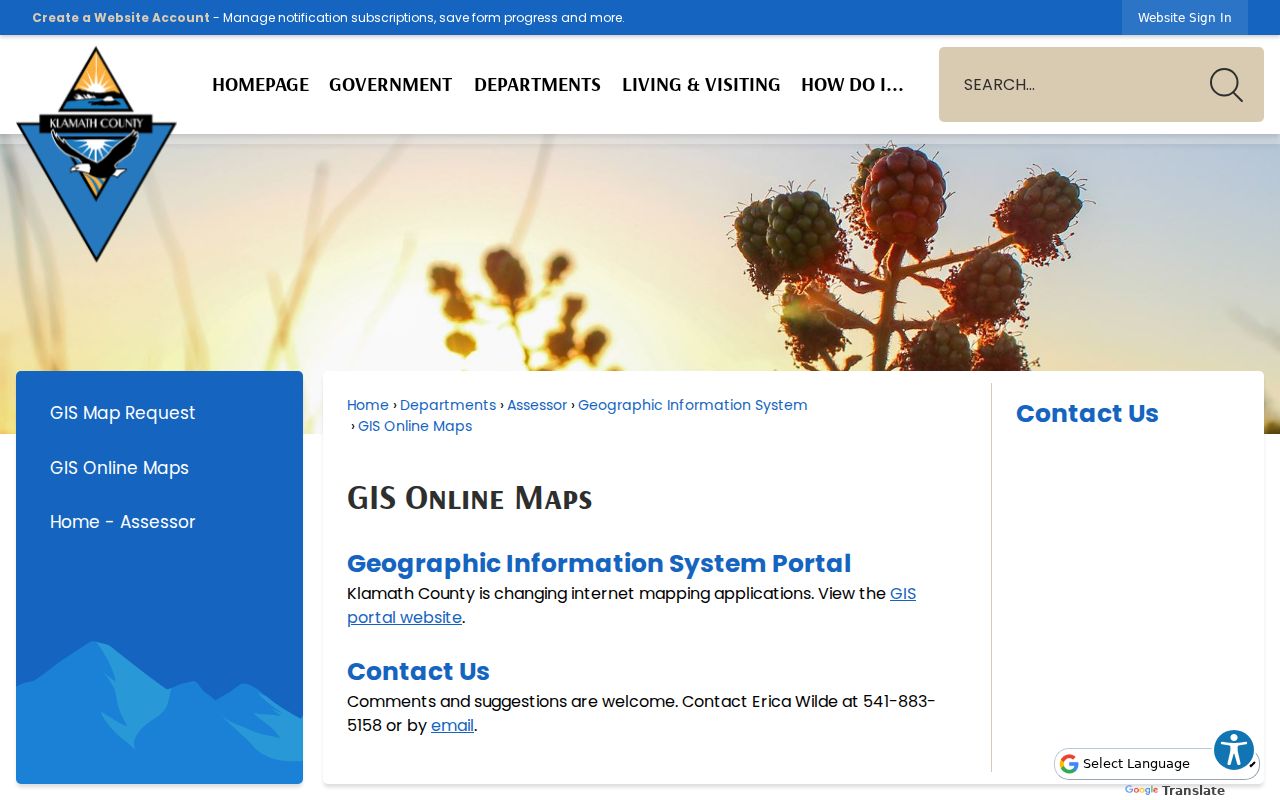
Land Explorer provides spatial context, such as parcel geometry, city limits, UGB, and district layers. The recorded deed remains the Clerk’s record, and the map does not independently establish title.
Klamath Falls Owners and Occupants Differ
An assessor result is one of the fastest resident-record leads, but it has a firm boundary. Klamath County’s Property Search Online can supply assessed value, value history, assessment details, owner and mailing address, sales history, prior tax statements, and deed-history leads. The owner and mailing fields describe the tax account. They are not a list of everyone living at the physical address. Use the parcel’s legal description and a recorded document to test an ownership question, then preserve the date rather than assuming the account tells a present household story.
- Parcel
- A defined piece of land in the assessment and map system, often identified locally by PropID or MTL.
- Situs address
- The physical location of land or an improvement, not necessarily where tax mail is sent.
- Mailing address
- The delivery address for the tax account, which can differ from the property’s physical location.
- Legal description
- The lot, block, subdivision, or survey description used to identify land in recorded documents.
The County Assessor property detail presentation shows the kind of parcel information that can begin a Klamath Falls residents directory inquiry. It should be read as a tax and assessment record, then checked against the Clerk when a deed or lien matters.
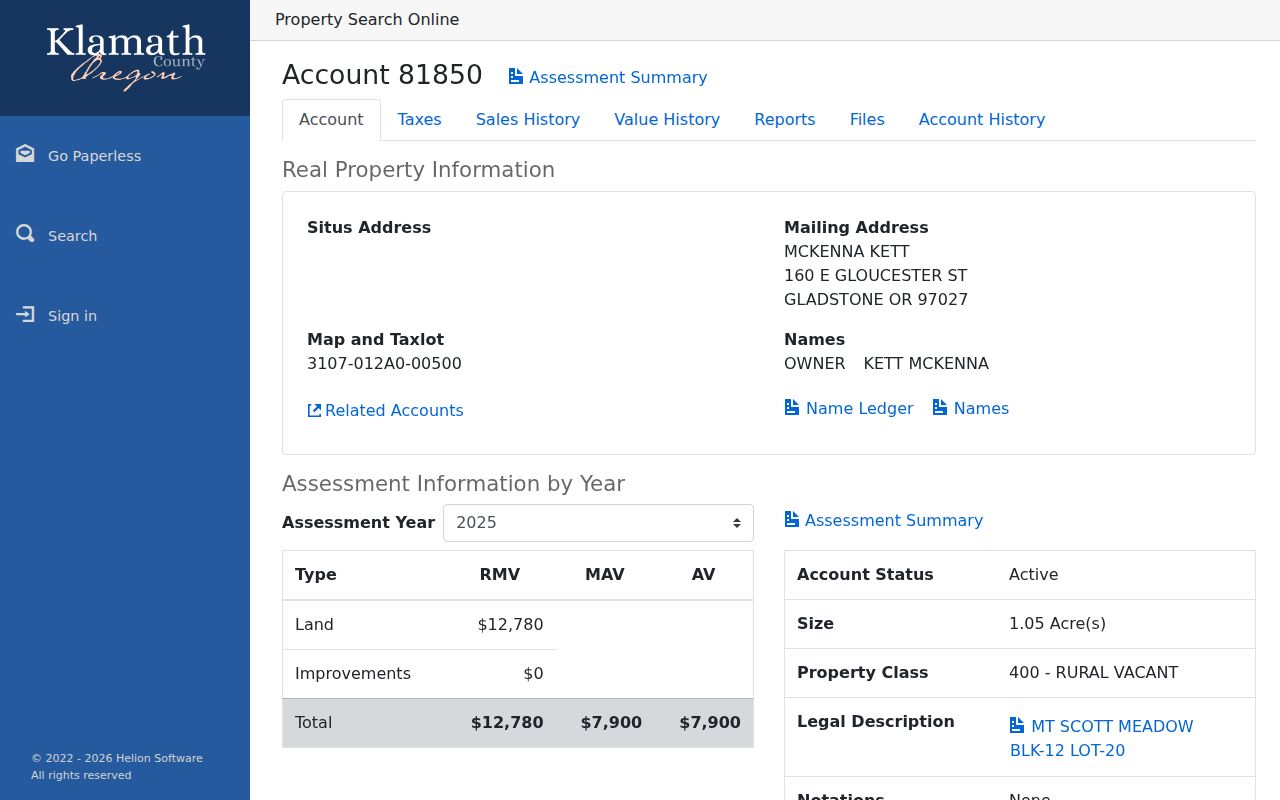
PSO’s Deed History and Sales areas can point to a transfer, while Land Explorer adds the MTL and map setting. Neither interface replaces a certified or official recorded instrument.
Current Klamath Falls Residents Directory Sources
Current sources have different coverage. The property roll follows taxable parcels and their tax contacts. The Clerk’s index follows parties to recorded documents. The court channel follows a case and its events. Oregon My Vote is for a voter to review that voter’s own registration information. A voter-list request is a separate, controlled records channel, and protected records remain protected. The Klamath Falls residents directory is therefore a comparison of dated sources, not a single current roster.
| Record source | What it can show | Local keeper | Access boundary |
|---|---|---|---|
| PSO and Land Explorer | Parcel owner, tax-mailing and situs data, assessment and deed leads | Klamath County Assessor and GIS | Owner or mailing contact is not proof of occupancy |
| Digital Research Room | Parties, document number, recording date, and recorded land instruments | Klamath County Clerk | Current direct access may require an account or session |
| OJD case services | Basic case identity, register events, and calendars | Klamath County Circuit Court | Free register omits document copies and protected cases |
| My Vote | A voter’s own registration and ballot-status information | Oregon Secretary of State | Not a public street or name roster |
| Historic collections | Dated directory, newspaper, yearbook, and census context | Museum, Library, and Archives | Historical evidence, not present residency |
A person-specific question needs a full-name and date comparison, not a loose address match. That verification sequence checks each result against the appropriate court, parcel, recording, or historic source.
Klamath Falls Voter Access Has Limits
Oregon My Vote is an individual service. A voter can check registration, review personal registration information, find county contacts, and update a move, name, mailing address, or party record. It is not a public by-street browse. The direct service was CAPTCHA-protected during research, so its visible search fields should not be guessed. Klamath County Elections, at 305 Main Street, is the local custodian for county voter-registration records and voter-address exemption requests.
The statewide voter-list request is a different channel. Oregon allows electronic statewide or less-than-statewide lists through the Secretary of State, while hardcopy, labels, and other nonelectronic local lists go to the appropriate county elections official. The research lists a $500 statewide price and a $25 setup charge plus 2.5 cents per 100 records for less-than-statewide electronic lists, with a stated 10-business-day allowance. Use the current official request instructions before payment because access, fees, and protected fields matter.
The official My Vote screen is the appropriate starting point for an individual’s own registration question.
Public voter-list data can include party affiliation, residence or mailing address when not protected, birth year, precinct, telephone number, and participation history. It never reveals ballot choices, and protected addresses remain excluded.
The state’s voter-list request page distinguishes that records-request channel from My Vote and identifies the available formats.
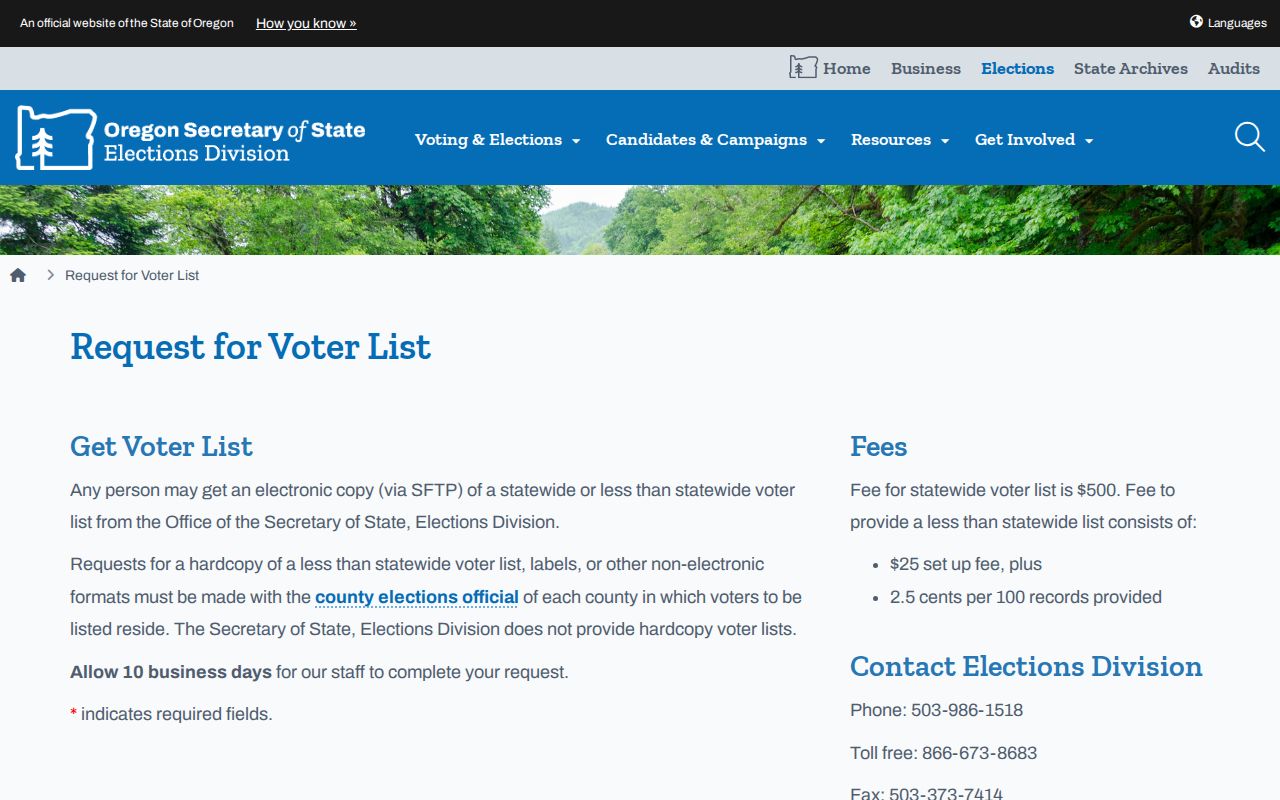
Oregon law restricts commercial use of voter lists, and confidential voters, ACP participants, and other protected records do not become public through a request.
Klamath Circuit Records Have Two Layers
Klamath County Circuit Court provides a useful identity and date check, but not a location directory. Oregon’s free Records and Calendar Search provides basic case information and calendars. A case register records events such as filings, hearings, notices, and judgments, but it does not include copies of the filed documents. OJCIN OnLine is the paid official service for registers and judgment records. The court where a case was filed remains the official custodian even when an online result appears current.
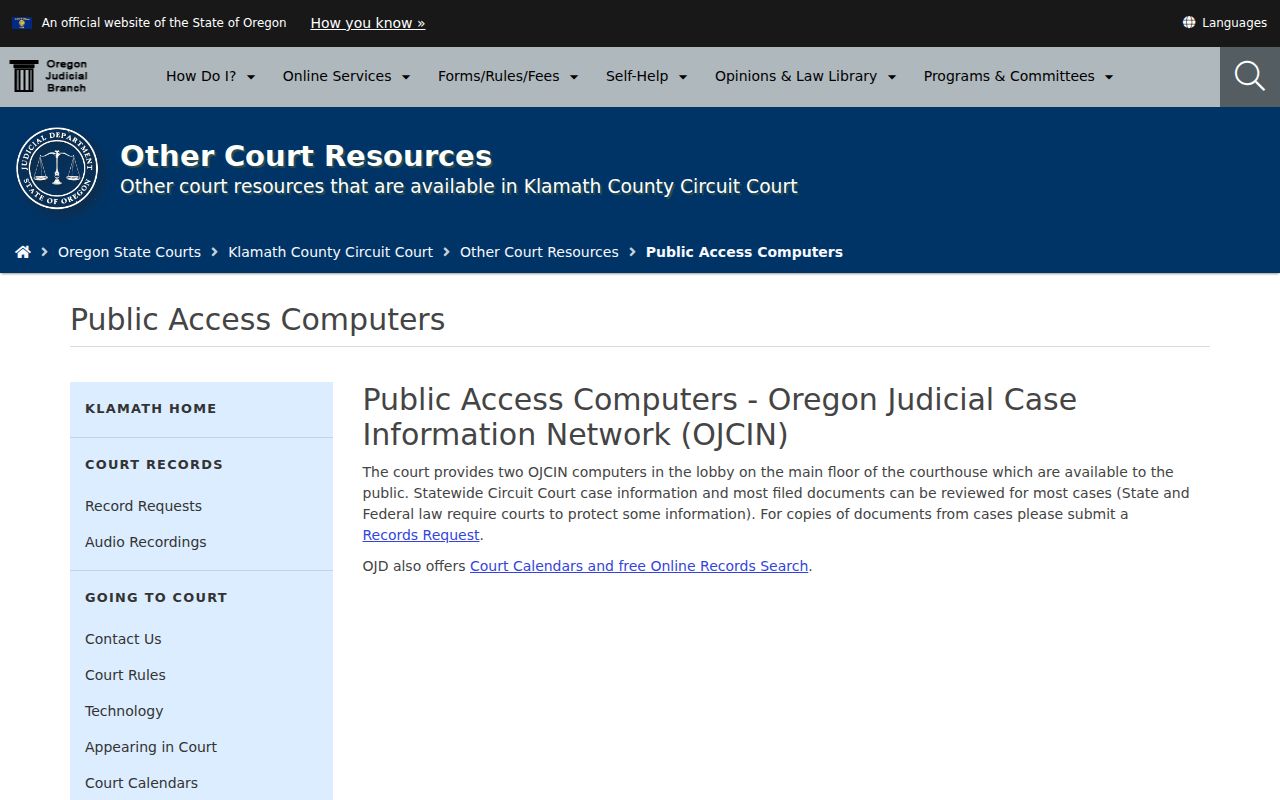
Klamath Circuit also provides two OJCIN public-access computers in its main-floor lobby. They can show statewide circuit-court information and most filed documents for most cases, subject to statutory protections. That is a practical local fallback when the free web layer is too thin. To request a copy, first note the case number and exact document or hearing date, then use the court’s records-request route. Adoption, juvenile, mental-health, and VAWA-protected matters stay outside ordinary public access.
The court’s public-access computer notice documents the local terminal option.
A case name can help distinguish similar people when paired with a case number, filing date, court, and party role. It does not establish a current address.
Note: A court register is a case-event record, not the complete file or a household directory.
Klamath Falls Vital Records Use a Short Local Window
Klamath County Public Health offers a local birth and death certificate route only for events that occurred in Klamath County within six months. The office lists a $25 certificate charge, photo identification, and payment by cash, check, Visa, or MasterCard. After six months, Oregon Health Authority is the proper certificate route. That division matters because a local counter is not a general historic-record search or a public name lookup.
| Route | Best for | Key limit |
|---|---|---|
| Klamath County Public Health | Eligible Klamath County birth or death event within six months | Local window ends after six months |
| Oregon Health Authority | Current Oregon certificates through its approved order channels | Eligibility and identification rules apply |
| Oregon State Archives | Historically open records and research services | Birth records close for 100 years; death, marriage, and divorce records close for 50 years |
Oregon’s vital-records ordering page identifies the state channel for certificates and its separate ordering methods.
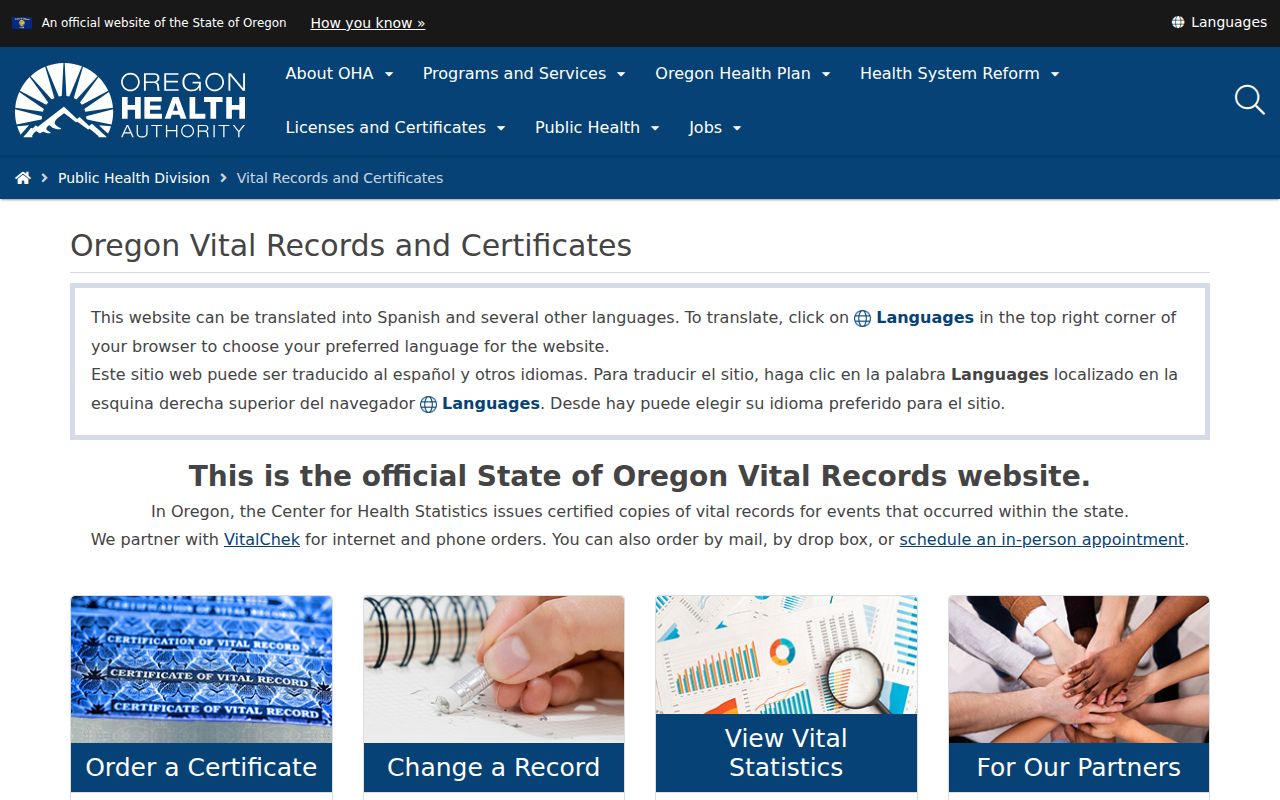
An eligible requester may use current certificate channels, while older open material can be researched through the Archives. A certificate is never a shortcut around the state’s access rules.
Klamath Falls City Requests Stay With the Recorder
City-created material belongs with the City Recorder at 500 Klamath Avenue, not with the County Clerk merely because Klamath Falls is the county seat. The City’s NextRequest route is the live submission path for city public records. Police-record requests route to the Klamath Falls Police Division. For a city permit, enforcement file, council item, or municipal document, identify the address, date range, and department. Check city limits first because a visibly urban property can be outside City jurisdiction and governed through Klamath County channels.
The City’s public-records page is the source-linked request route for Klamath Falls municipal material.
The City also maintains a document library for formal minutes, resolutions, ordinances, budgets, and related materials. Those documents can supply a dated property or project lead, but they are not a resident list.
The County’s public-records request page is the separate route for county-held department material outside the Clerk and court systems.
Under Oregon Public Records Law, ORS chapter 192, a focused written request generally must be acknowledged or completed within five business days, then completed as soon as practicable. A lawful fee estimate can pause fulfillment.
Historical Klamath Falls Residents Directory Sources
Klamath County Museums holds the verified digital core for a historical Klamath Falls residents directory search: scanned and searchable volumes for 1905, 1909, and 1920. Treat those three years as a real collection, not as proof of an unbroken printed run. A directory entry can supply a spelling, initials, address, occupation or business wording when printed, and a dated connection to place. It cannot prove anyone currently lives at that address.
For family or house history, copy an entry exactly, then compare it with the Museum’s 1899 to 1909 headline index, Historic Oregon Newspapers, a released federal census, and a deed’s legal description. The Main Library adds in-building Ancestry Library Edition and FamilySearch Affiliate access, plus remote HeritageQuest for library-card users. For the collection years and how to read them in depth, use the Klamath Falls city directories collection page.
The County Museum Research Pages hub brings those historical sources together.
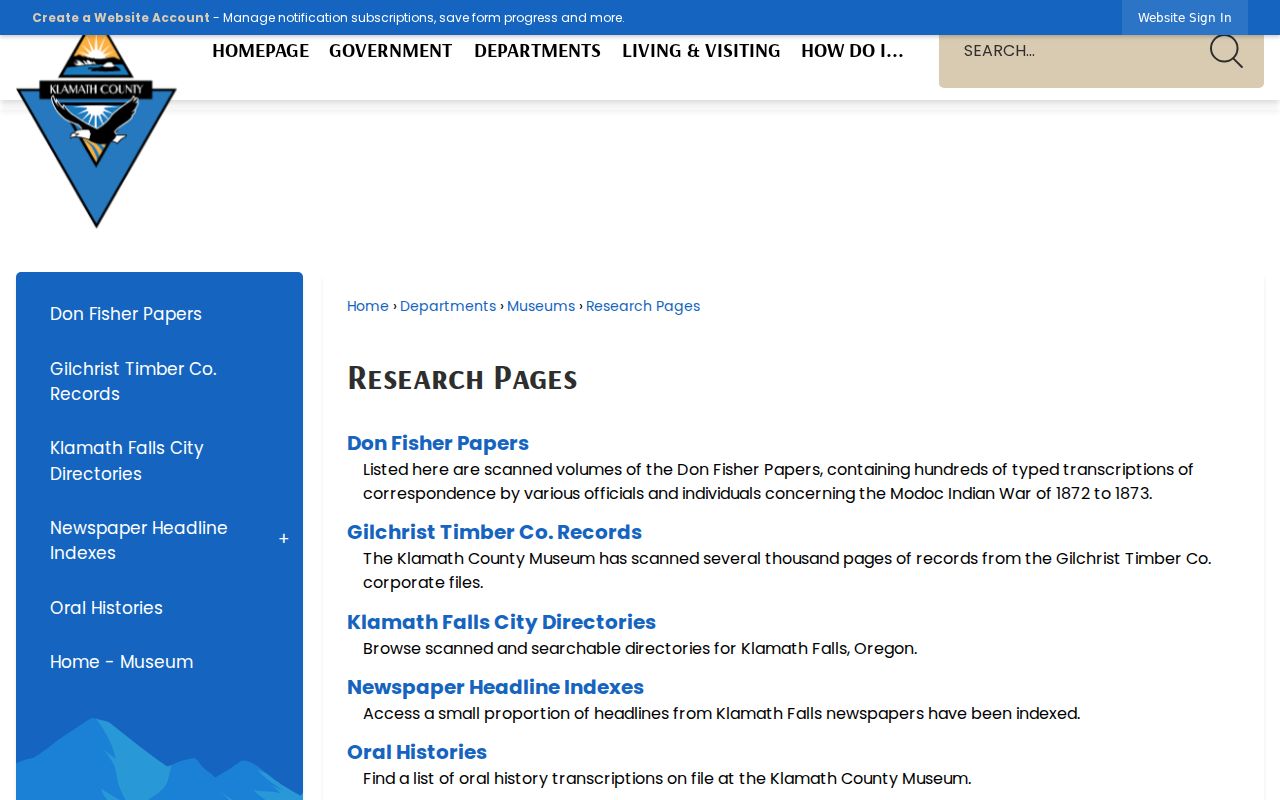
Historical collections supply dated context. A transfer date, newspaper notice, census entry, and directory listing should be cited as separate evidence rather than merged into a claim of continuous occupancy.
Klamath Falls Records Begin With Linkville
Older Klamath Falls research needs a second place name. The settlement was known as Linkville before it was renamed Klamath Falls in 1893. Klamath County was formed from Lake County in 1882. An early deed, map, newspaper, or land reference may therefore appear under Linkville or lead into Lake County context. Searching only the modern city name can hide a useful historical result, especially when a record uses a legal description instead of a familiar street address.
Date also determines the route. State Archives inventory identifies deed volumes beginning in 1871, direct and indirect indexes beginning in the 1870s, and Klamath probate records from 1882 through 2015. It identifies OJIN in 1988 and OECI in 2015 as system eras, not a promise that all earlier files are online. The Museum’s verified digital directories are 1905, 1909, and 1920. No source in the research supports inventing missing directory years or a continuous online court history.
The documented assessment gap is just as important. Continuing tax-roll cards for 1938 through 1964 were severely water damaged or destroyed, although deeds, plats, surveys, road records, and other holdings may still offer a route around that gap.
Klamath County Alerts Are Not Title Checks
Klamath County’s free Property Record Alert Service monitors enrolled names and sends same-day email alerts when a new document is recorded. It can track up to 10 names per email address. The service does not search historical records, stop a document from being recorded, authenticate a filing, or interpret a document. A common name can also produce an unrelated hit. An alert is a prompt to inspect the actual instrument and confirm its parties and document number with the Clerk.
That local distinction matters in a Klamath Falls residents directory search. A new recording may show a property event, but it does not by itself resolve title, identity, or who currently occupies an address.
Klamath Falls Privacy and Record Corrections
Oregon’s Consumer Privacy Act, ORS 646A.570 through .589, can give qualifying consumers rights against covered private controllers to access, correct, delete, or opt out of certain use of personal data. It does not erase an original Clerk deed, Assessor account, court file, or other government source. Public bodies and data lawfully available through government records have separate treatment. For a private-company copy, Oregon’s Data Broker Registry can identify a broker’s published opt-out method. For a government record, ask the office holding it about correction, redaction, or an exemption process.
Safety protections have their own channels. Oregon’s Address Confidentiality Program is a free mail-forwarding service for survivors of domestic violence, sexual assault, stalking, or human trafficking. A voter may use SEL 550 through the county clerk to seek an exemption of a residence address from public disclosure. A qualifying person can also seek an address, phone, or email withholding from each relevant public body when a safety danger applies. These protections are record-specific and do not move automatically across every office.
Oregon law also addresses knowing nonconsensual disclosure of personal information when it is tied to stalking, injury, or property damage. If a government record is wrong, contact its custodian with supporting documentation rather than trying to change the conclusion through another database.